
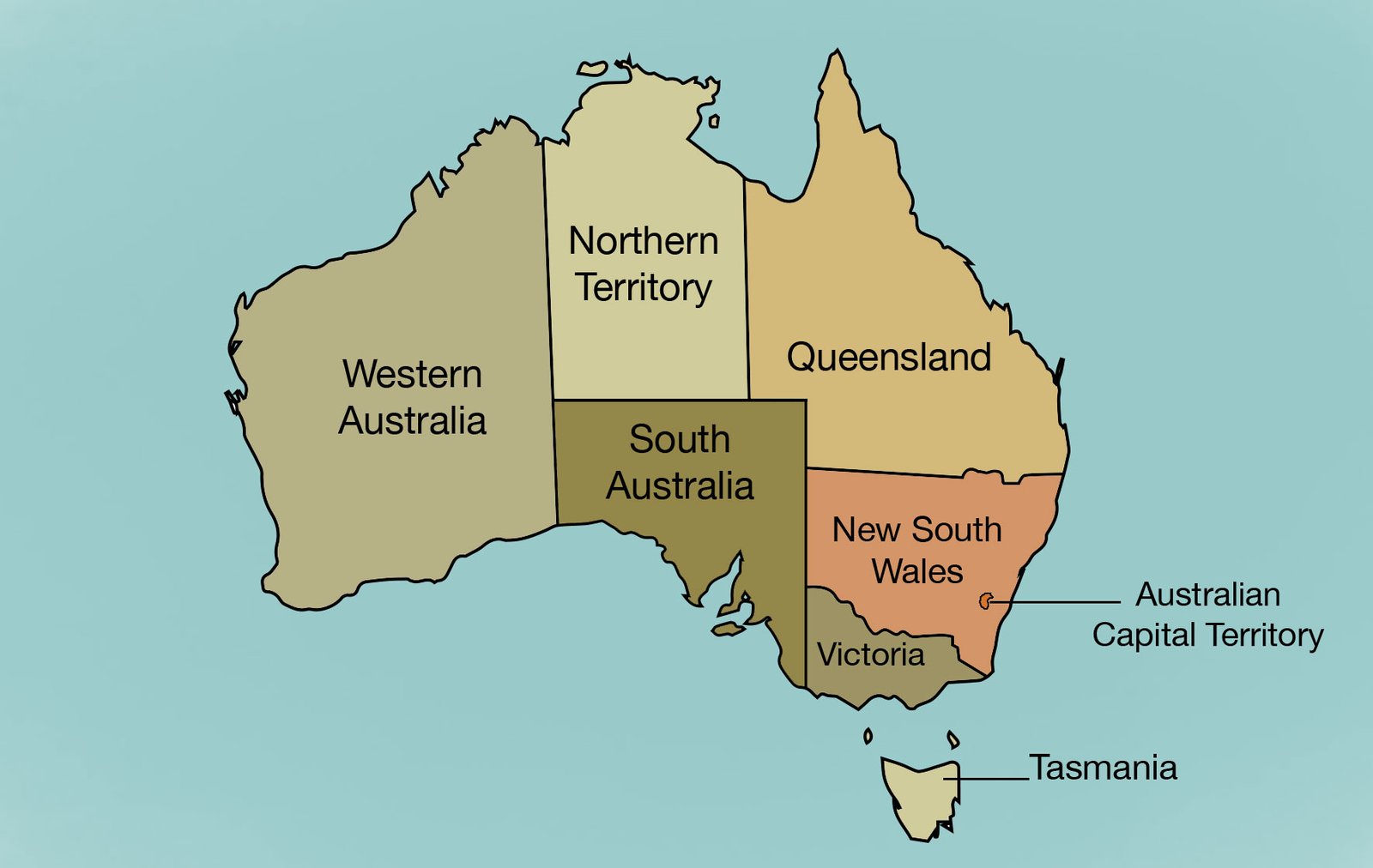
Australia has six federated states and two territories: New South Wales, Victoria, Queensland, Western Australia, South Australia, Tasmania, and the Northern Territory and the Australian Capital Territory.
Australia is one of those countries that surprises people the moment they start paying real attention to it. On a map it looks like a single enormous landmass — and it is — but politically, culturally, and geographically, it is a federation of eight distinct states and territories, each with its own government, its own personality, its own landscape, and its own story. I’ve spent years reading about, traveling through, and thinking about this country, and every time I go back to basics and look at Australia state by state, I find something new that I hadn’t fully appreciated before.
List of States and Territories in Australia – Alphabetical order
- Australian Capital Territory
- New South Wales
- Northern Territory
- Queensland
- South Australia
- Tasmania
- Victoria
- Western Australia
List of States and their capitals in Australia
- New South Wales (NSW): Capital: Sydney
- Victoria (VIC): Capital: Melbourne
- Queensland (QLD): Capital: Brisbane
- Western Australia (WA): Capital: Perth
- South Australia (SA): Capital: Adelaide
- Tasmania (TAS): Capital: Hobart
List of territories and their capitals in Australia
- Northern Territory (NT): Capital: Darwin
- Australian Capital Territory (ACT): Capital: Canberra
List of Other Australian Territories:
- Jervis Bay Territory: A small area on the coast of New South Wales, administered by the Commonwealth
- Christmas Island: An Australian territory in the Indian Ocean
- Cocos (Keeling) Islands: An Australian territory in the Indian Ocean
- Ashmore and Cartier Islands: A group of islands in the Timor Sea
- Coral Sea Islands: A group of islands in the Coral Sea
- Heard Island and McDonald Islands: A group of islands in the Southern Ocean
- Norfolk Island: An Australian territory in the Pacific Ocean
1. Australian Capital Territory (ACT)
The Australian Capital Territory is Australia’s smallest and perhaps most misunderstood jurisdiction. Carved out of New South Wales in 1911 specifically to serve as a neutral home for the federal government — after Sydney and Melbourne couldn’t agree on which of them should be the national capital — the ACT is a purpose-built political entity in a way that very few places in the world are. Its capital, Canberra, which is also the national capital of Australia, was designed by American architects Walter Burley Griffin and Marion Mahony Griffin after they won an international design competition in 1912. The result is an unusually planned, green, and spacious city of around 470,000 people that is often described by Australians who’ve never lived there as boring, and by those who do live there as one of the most livable cities in the country.
The ACT covers just 2,358 square kilometers — tiny by Australian standards — and is entirely surrounded by New South Wales. It has a population of about 470,000 people, making it the second-smallest jurisdiction by population after the Northern Territory. What it lacks in size it makes up for in concentration of political power, institutional density, and green space. Over 55% of the ACT’s land area is protected as nature reserve, and Namadgi National Park alone covers more than half the territory. Canberra is home to Parliament House, the Australian War Memorial, the National Gallery of Australia, the National Library, and the Australian National University — one of the country’s most prestigious research universities. The ACT also made history as one of the first jurisdictions in Australia to legalize same-sex marriage (before the national legislation passed in 2017) and has consistently positioned itself as one of Australia’s most progressive political communities.
2. New South Wales (NSW)
New South Wales is where Australia’s story, in its modern European chapter, began. The First Fleet arrived at Botany Bay in January 1788, and the colony established at Sydney Cove became the seed from which the entire Australian federation eventually grew. Today, New South Wales is the most populous state in Australia, home to approximately 8.4 million people in 2026, and its capital Sydney is the country’s largest city with a metropolitan population of around 5.3 million.
Sydney is Australia’s global face — the Opera House, the Harbour Bridge, Bondi Beach, the Blue Mountains within 90 minutes of the CBD — and it is genuinely one of the world’s great cities by almost any measure. But New South Wales is far more than Sydney. It covers 801,150 square kilometers, stretching from the humid subtropical coast of the north all the way to the alpine areas near Thredbo and Perisher in the south, and westward across the vast tablelands and plains that eventually merge into the Outback. The Hunter Valley is one of Australia’s premier wine regions. Byron Bay has become a global wellness and creative destination. Coffs Harbour, Newcastle, Wollongong, and Dubbo are cities with their own distinct economies and communities.
New South Wales has the largest economy of any Australian state, contributing around a third of the national GDP. Finance, professional services, healthcare, education, and construction are its biggest sectors, though agriculture in the state’s interior — wool, wheat, beef, and cotton — remains a significant part of the rural economy. For anyone trying to understand Australia’s economic engine, they need to understand New South Wales first.
3. Northern Territory (NT)
The Northern Territory occupies a special place in the Australian imagination — and in the Australian reality. It is vast (1,349,129 square kilometers, making it the third-largest jurisdiction by area), sparsely populated (around 250,000 people, the smallest population of any state or territory), and home to some of the most extraordinary landscapes and most significant Indigenous cultural heritage on the continent. Darwin, its capital, is Australia’s only tropical capital city — a small, multicultural, cyclone-hardened city of around 150,000 people that sits closer to Jakarta than it does to Sydney.
The Northern Territory is not a state — a fact that carries real political consequences. As a territory, it is subject to federal government override in a way that states are not, and this has been controversially exercised. The Northern Territory contains Uluru (formerly Ayers Rock), one of the most sacred sites in Aboriginal Australian culture and one of the most recognizable natural landmarks in the world. It contains Kakadu National Park, a UNESCO World Heritage Site of staggering ecological and cultural significance. It contains the MacDonnell Ranges, Katherine Gorge, Litchfield National Park, and the vast Tanami and Simpson deserts.
Aboriginal Australians make up approximately 30% of the Northern Territory’s population — the highest proportion of any jurisdiction in Australia — and Aboriginal land rights cover around 50% of the Territory’s land area. The relationship between the Territory government, the federal government, and Aboriginal communities has been one of the defining and most contested political questions in Australian public life for decades. The NT remains a place of profound beauty, deep complexity, and significant socioeconomic challenges that Australia as a nation is still grappling to address honestly.
4. Queensland
Queensland is Australia’s sunshine state in every sense — literally, because its subtropical and tropical climate delivers more sunshine hours than almost anywhere else in the country, and figuratively, because it carries an optimism and physical exuberance that feels embedded in its culture. It is the second-largest state by area at 1,852,642 square kilometers and the third-most populous with approximately 5.6 million people in 2026. Its capital, Brisbane, recently emerged from the 2032 Olympic hosting preparations with a newly polished global profile and a skyline that has grown dramatically in the past decade.
The Queensland coast is one of the wonders of the natural world. The Great Barrier Reef — the world’s largest coral reef system, stretching over 2,300 kilometers along the state’s coast — is a UNESCO World Heritage Site that draws millions of visitors annually, though its long-term health under the pressure of climate change-driven coral bleaching events has become one of Australia’s most urgent environmental concerns. The Gold Coast, just south of Brisbane, is Australia’s version of Miami — a high-rise beach strip built entirely around tourism, entertainment, and lifestyle. Cairns in the far north is the gateway to both the Reef and the Daintree Rainforest, the world’s oldest tropical rainforest. Townsville, Rockhampton, Toowoomba, and the Darling Downs agricultural region round out a state of remarkable internal diversity.
Queensland’s economy runs on resources, tourism, agriculture, and construction. It is Australia’s largest producer of coal (though the energy transition is creating real economic questions for coal-dependent communities like those in the Bowen Basin), a major exporter of beef and sugar, and a growing hub for renewable energy infrastructure. The state has also attracted significant interstate migration over the past decade, with Australians moving north from NSW and Victoria drawn by the combination of lower housing costs, lifestyle amenity, and economic opportunity.
5. South Australia (SA)
South Australia has always been slightly different from the rest of the country, and it wears that difference with quiet pride. Unlike New South Wales, Victoria, and Queensland, South Australia was not founded as a convict settlement — it was established in 1836 as a “free province,” planned according to Enlightenment principles of land sales and self-governance, and that founding ethos of progressivism has echoed through its history ever since. South Australia was the first place in the world to give women the right to vote and stand for parliament in 1894. It decriminalized homosexuality in 1975, a decade before most of the rest of Australia. And today it consistently positions itself as a national leader on renewable energy — at times generating more than 100% of its electricity needs from wind and solar.
The state covers 983,482 square kilometers and has a population of approximately 1.9 million, with around 1.4 million of those living in the capital Adelaide. Adelaide is often unfairly dismissed by residents of Sydney and Melbourne, but anyone who has spent real time there knows it as a genuinely livable, culturally rich, and increasingly exciting city. The Adelaide Hills, the Barossa Valley and Clare Valley wine regions, the Fleurieu Peninsula, Kangaroo Island, and the Flinders Ranges are all within reach of the city. The Barossa in particular is home to some of the world’s greatest Shiraz, grown from vines that in some cases date back to the 1840s.
South Australia’s economy has historically leaned on manufacturing, which has declined since the closure of the local automotive industry, but it is rebuilding around defence industries (the Naval Group submarine program, now reconfigured under the AUKUS partnership), renewable energy, agriculture, and health and medical technology. The state is also home to the Olympic Dam mine, one of the world’s largest deposits of uranium, copper, gold, and silver.
6. Tasmania
Tasmania is the only Australian state that is an island — separated from the mainland by the Bass Strait, about 240 kilometers of notoriously rough Southern Ocean water. And that geographical separation has given Tasmania a character unlike anywhere else in Australia. It is smaller (68,401 square kilometers), cooler, greener, and more dramatically wild than the mainland. Its population of around 580,000 makes it the second-smallest state by population, and its capital Hobart — Australia’s second-oldest city after Sydney — sits at the foot of the imposing kunanyi/Mount Wellington.
Tasmania is covered in temperate rainforest, alpine wilderness, and World Heritage–listed wild areas that make up nearly 40% of the state’s total land area. The Tasmanian Wilderness World Heritage Area is one of the largest temperate wilderness areas in the Southern Hemisphere. The Franklin River, saved from damming in one of Australia’s most significant conservation campaigns in the 1980s, still runs wild through its heart. Cradle Mountain, Freycinet Peninsula, and the Bay of Fires are landscapes that genuinely stop people in their tracks.
In recent years Tasmania has undergone a remarkable cultural renaissance driven partly by MONA — the Museum of Old and New Art, opened by eccentric multimillionaire gambler David Walsh in 2011 — which has transformed Hobart’s cultural profile and tourism economy in ways that continue to ripple outward. Tasmania’s food and wine scene, built on clean cold-water seafood, world-class pinot noir, heritage agriculture, and artisan producers, has become one of Australia’s finest.
7. Victoria
Victoria is Australia’s second-most populous state at approximately 6.9 million people and its second-largest economy, yet it is the mainland’s smallest state by area at just 237,629 square kilometers. That combination of small size and large population makes Victoria — and particularly its capital Melbourne — the most densely settled part of the Australian mainland. Melbourne is Australia’s second-largest city with a metropolitan population of around 5.2 million, and it has long engaged in a friendly but genuine rivalry with Sydney over which of them is the country’s true cultural capital.
Most Australians will tell you, with varying degrees of bias, that Melbourne wins that argument on food, coffee, arts, sport, and fashion, while Sydney wins on beaches and physical beauty. Both arguments have merit. Melbourne is Australia’s sporting capital in the sense that it hosts the Australian Open (tennis), the Formula One Australian Grand Prix, the Melbourne Cup (horse racing), and is the spiritual home of Australian Rules Football, which was invented there in 1858. Its restaurant and café scene is internationally regarded, its laneway culture is genuinely unique, and its inner suburbs — Fitzroy, Collingwood, Brunswick, St Kilda, Prahran — have a creative density that few cities anywhere can match.
Beyond Melbourne, Victoria contains the Great Ocean Road (one of the world’s most spectacular coastal drives), the Yarra Valley and Mornington Peninsula wine regions, the Grampians, the Victorian Alps, and the goldfields towns of Ballarat and Bendigo that were built on the wealth of the 1850s Gold Rush and still carry extraordinary architectural heritage from that era.
8. Western Australia (WA)
Western Australia is, simply put, enormous. At 2,529,875 square kilometers, it is the largest state in Australia and the largest sub-national jurisdiction in the world by area after Russia’s Sakha Republic. It covers approximately 33% of Australia’s total land area. Yet its population of around 2.9 million is concentrated almost entirely in and around its capital Perth, which sits on the Indian Ocean coast and is, famously, the most isolated major city in the world — closer to Singapore than to Sydney, and separated from the eastern states by the vast Nullarbor Plain.
Perth’s isolation has historically given Western Australians a slight chip on their shoulder about being ignored by Canberra and the east-coast establishment, and that feeling has occasionally bubbled into real political tension, including a secession referendum in 1933 in which Western Australians voted two-to-one to leave the federation (the vote was ultimately not acted upon by the British Parliament). Today, that isolation feels less like a disadvantage and more like a defining asset — Perth is a genuinely beautiful, sunny, and increasingly sophisticated city that has developed its own distinct cultural identity.
Western Australia’s economy is built on resources to an extraordinary degree. The state contains some of the world’s richest iron ore deposits, particularly in the Pilbara region, and companies like BHP, Rio Tinto, and Fortescue Metals have extracted billions of tonnes of ore that have made Western Australia — and to a significant degree the whole of Australia — wealthy. The state is also a major producer of gold, lithium (increasingly critical for battery technology), natural gas (the North West Shelf and Browse Basin make WA one of the world’s largest LNG exporters), and wheat.
The south-west of WA — the Margaret River wine region, the karri and jarrah forests, the coastline around Albany and Esperance — is one of Australia’s most beautiful and biodiverse corners, home to flowering plants found nowhere else on Earth and beaches of a whiteness and clarity that genuinely have to be seen to be believed.
Sources and data: Australian Bureau of Statistics (ABS) 2025–2026 population estimates, Geoscience Australia land area data, state and territory government official statistics, UNESCO World Heritage listings, and parliamentary records.