
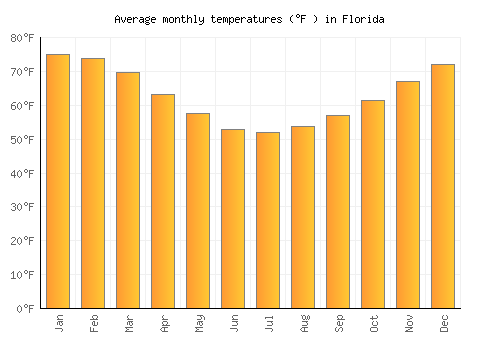
Florida is known for its warm climate, but temperatures vary considerably across the state throughout the year. The figures below show Florida’s average monthly and annual temperatures based on weather station data collected from 1991 to 2020 by the U.S. National Centers for Environmental Information (NCEI).
Florida’s Average Monthly Temperatures
Florida’s statewide average temperature is about 72.1°F (22.3°C) for the entire year. July and August are typically the hottest months, with an average temperature of 82.6°F (28.1°C). January is the coolest month, averaging 59.3°F (15.2°C).
| Month | Average °F | Average °C |
|---|---|---|
| January | 59.3°F | 15.2°C |
| February | 62.1°F | 16.7°C |
| March | 66.0°F | 18.9°C |
| April | 71.1°F | 21.7°C |
| May | 76.7°F | 24.8°C |
| June | 81.0°F | 27.2°C |
| July | 82.6°F | 28.1°C |
| August | 82.6°F | 28.1°C |
| September | 80.6°F | 27.0°C |
| October | 74.7°F | 23.7°C |
| November | 67.0°F | 19.4°C |
| December | 62.0°F | 16.6°C |
| Entire Year | 72.1°F | 22.3°C |
Temperatures begin rising steadily from winter into spring. By May, the statewide average reaches 76.7°F (24.8°C), climbing above 80°F in June. The warmest conditions generally occur in July and August before temperatures begin to ease during September and October.
How Much Do Temperatures Vary Across Florida?
Statewide monthly averages provide a useful overview, but they do not tell the whole story. Florida’s climate varies significantly from one part of the state to another.
Southern Florida generally experiences the highest temperatures, while the Florida Panhandle and parts of the northeast tend to be cooler. Coastal location, latitude and proximity to the Gulf of Mexico and Atlantic Ocean all contribute to these differences.
The table below shows the approximate range of average high and low temperatures recorded across different locations in Florida during each month.
| Month | Average High Range °F | Average Low Range °F | Average High Range °C | Average Low Range °C |
|---|---|---|---|---|
| January | 78–60°F | 66–36°F | 26–16°C | 19–2°C |
| February | 81–64°F | 68–40°F | 27–18°C | 20–4°C |
| March | 83–69°F | 70–45°F | 29–21°C | 27–7°C |
| April | 87–75°F | 73–52°F | 31–24°C | 23–11°C |
| May | 91–82°F | 77–60°F | 33–28°C | 25–15°C |
| June | 93–86°F | 80–67°F | 34–30°C | 27–19°C |
| July | 94–88°F | 81–69°F | 34–31°C | 27–21°C |
| August | 94–88°F | 81–69°F | 35–31°C | 27–20°C |
| September | 93–86°F | 80–65°F | 34–30°C | 27–18°C |
| October | 89–79°F | 78–54°F | 32–26°C | 25–12°C |
| November | 84–70°F | 73–43°F | 29–21°C | 23–6°C |
| December | 80–63°F | 69–39°F | 27–17°C | 20–4°C |
| Entire Year | 87–77°F | 75–53°F | 31–25°C | 24–12°C |
Where Are Florida’s Hottest and Coolest Areas?
The warmest daytime temperatures are generally found in southern Florida. Cities such as Pompano Beach, Hialeah and Miami commonly experience some of the state’s highest average daytime temperatures.
In contrast, the coolest average daytime highs are more common in northern and coastal areas, including Pensacola, Panama City, Jacksonville Beach and Fernandina Beach.
Nighttime temperatures show a similar geographic pattern. Key West typically has some of Florida’s warmest nights, while Tavernier and Miami also remain relatively warm after sunset.
Some of the coldest nighttime temperatures occur farther north and inland. DeFuniak Springs, Niceville near Fort Walton Beach, and Fountain near Panama City are among the locations where average minimum temperatures can be considerably lower than those found in southern Florida.
Florida’s Climate Throughout the Year
Overall, Florida remains warm for much of the year. Winter brings the state’s coolest temperatures, particularly in northern Florida and the Panhandle, while spring temperatures rise quickly.
Summer is consistently hot, with statewide average temperatures around or above 80°F. July and August are typically the peak of the heat. Temperatures begin declining in September and become noticeably milder by October and November.
Because Florida stretches from the northern Panhandle to the tropical southern tip, travelers and residents can experience substantially different temperatures depending on where they are in the state.
At a Glance
- Annual statewide average: 72.1°F (22.3°C)
- Coolest month: January — 59.3°F (15.2°C)
- Warmest months: July and August — 82.6°F (28.1°C)
- Hottest areas: Generally southern Florida
- Cooler areas: The Panhandle and parts of northeast Florida
- Warmest nights: Typically around Key West and the southern Florida Keys
Reference
NOAA National Centers for Environmental Information (NCEI). Climate Normals.