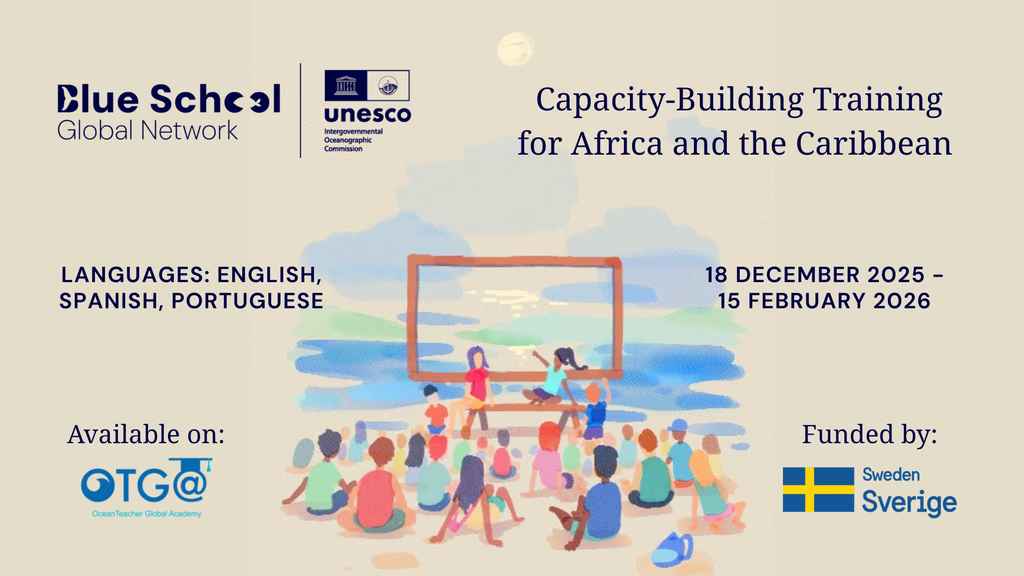
UNESCO — Blue Schools Capacity-Building Training – Africa & Caribbean Regions for teachers and coordinators
Summary
The Blue School Capacity-Building Training – Africa & Caribbean Regions is an initiative of the Intergovernmental Oceanographic Commission (IOC–UNESCO), developed under the umbrella of the Ocean Teacher Global Academy (OTGA) and aligned with the Ocean Literacy With All (OLWA) programme and the Global Blue Schools Network (GBSN).
This course is developed under the framework of the UN Decade of Ocean Science for Sustainable Development (2021–2030) and contributes to UNESCO–IOC’s mandate to strengthen Ocean Literacy, capacity development, and equitable access to ocean knowledge. Africa and the Caribbean include many countries where marine education infrastructures, teacher training systems, and ocean-related resources remain limited. Strengthening Ocean Literacy in these regions is essential not only for educational quality, but also for community resilience, climate adaptation, blue economy opportunities, and sustainable development.
By providing a common global framework adapted to local realities, this training responds to the Decade’s call for inclusive and transformative capacity development. It aims to reduce global inequalities in access to knowledge, support national institutions in creating sustainable Blue School networks, and empower educators to act as agents of change in their communities. Through multilingual resources, South–South collaboration, and shared lighthouse projects, the course helps create enabling conditions for long-term sustainability and regional ocean stewardship.
This initiative also supports the Ocean Literacy with All (OLWA) programme, fostering communities of practice that integrate science, education, and local knowledge. By strengthening coordination mechanisms and supporting culturally relevant learning, the course contributes to building a Decade Legacy where Ocean Literacy is embedded into national education systems and supported by sustainable partnerships.
Purpose
To develop capacities of national/regional coordinators and teachers in Africa and the Caribbean to implement, expand, and sustain the Blue School Programme using a shared global framework adapted to local realities.
Learning outcomes
The course aims to strengthen participants’ understanding of the Blue School model, integrating Ocean Literacy and ESD principles, while providing coordinators with practical procedures to establish and scale national networks. It also seeks to equip teachers to design certification-ready Blue School projects, promote regional collaboration through the Blue Helpdesk, and reinforce the implementation and visibility of lighthouse projects. Overall, the training contributes directly to IOC’s broader mission of ocean empowerment and capacity development.
The course has specific objectives tailored to coordinators and teachers.
For coordinators, it aims to support the design of national coordination structures, the development of school onboarding and monitoring processes, the establishment of national partner networks, and the drafting of three-year action plans with clear indicators.
For teachers, the training focuses on helping them integrate Ocean Literacy and ESD into their practice, develop Blue School projects aligned with certification criteria, collaborate across disciplines, and implement lighthouse projects in their school contexts.
Course content for the teacher pathway
M1: course structure and introduction
M2: What is a blue school?
M3: Becoming a Blue School
M4 : teacher testimonies
M5: Partner Network and inspiring projects
M6: Lighthouse training – junior coastal monitoring
Course content for the National and Regional coordinators pathway
M1: course structure and introduction
M2: What is a blue school?
M3: Building a national Coordination team
M4 : Engaging and supporting schools
M5: Partnerships and lighthouse projects
M6: planning, monitoring and evaluation
Language of instruction
English, Spanish, Portuguese
Instructors
Raquel Lorenz Costa (IOC–UNESCO)
Natacha Moreira (Oceano Azul Foundation)
Hugo Jesus (Oceanário de Lisboa)
Oluwabunmi Yetu-Ande
Veronica Relano
Notes
Target audience
• National and regional Blue School coordinators
• Teachers and educators
• Members of related networks
• NGOs and government bodies
Estimate course duration
– teachers: 12 hours
– coordinators: 10 hours
Enrolment
Course: https://classroom.oceanteacher.org/course/view.php?id=1284
code to enrol: BSGN-teachers#1284
code to enrol: BSGN-coord#1284
enrolement open 15 December 2025 and close 15 February 2026.
Learner assessment
this course will have pre test – quizzes during the course and a final assessment that needs to be completed by a certain date to be graded by the end of the course.
Assigments can be completed till 20 February 2026
Certificate
Participants must complete the required module activities. Coordinators must submit their final National Action Plan.
Teachers must submit a final Google Form reflection, explaining:
-
how they plan to apply what they learned in their classroom/school,
-
an example of a project that meets the Blue School criteria, and
-
how they would prepare the implementation of the lighthouse project.
There are no exams; the assessment is fully based on practical, applied tasks.
Technology requirements/computer skills
-
A computer or mobile device with a stable internet connection
-
The ability to watch video content
-
Basic digital skills (opening documents, uploading simple assignments, reading PDFs)
-
No advanced IT skills are required.
Pre-requisites
none
Cost
This course has no tuition fees.
UNESCO is committed to promoting equal access principles. Applications from minority or underrepresented groups are strongly encouraged.